agentic-commerce
Your 3D Model Just Became a Feed Field
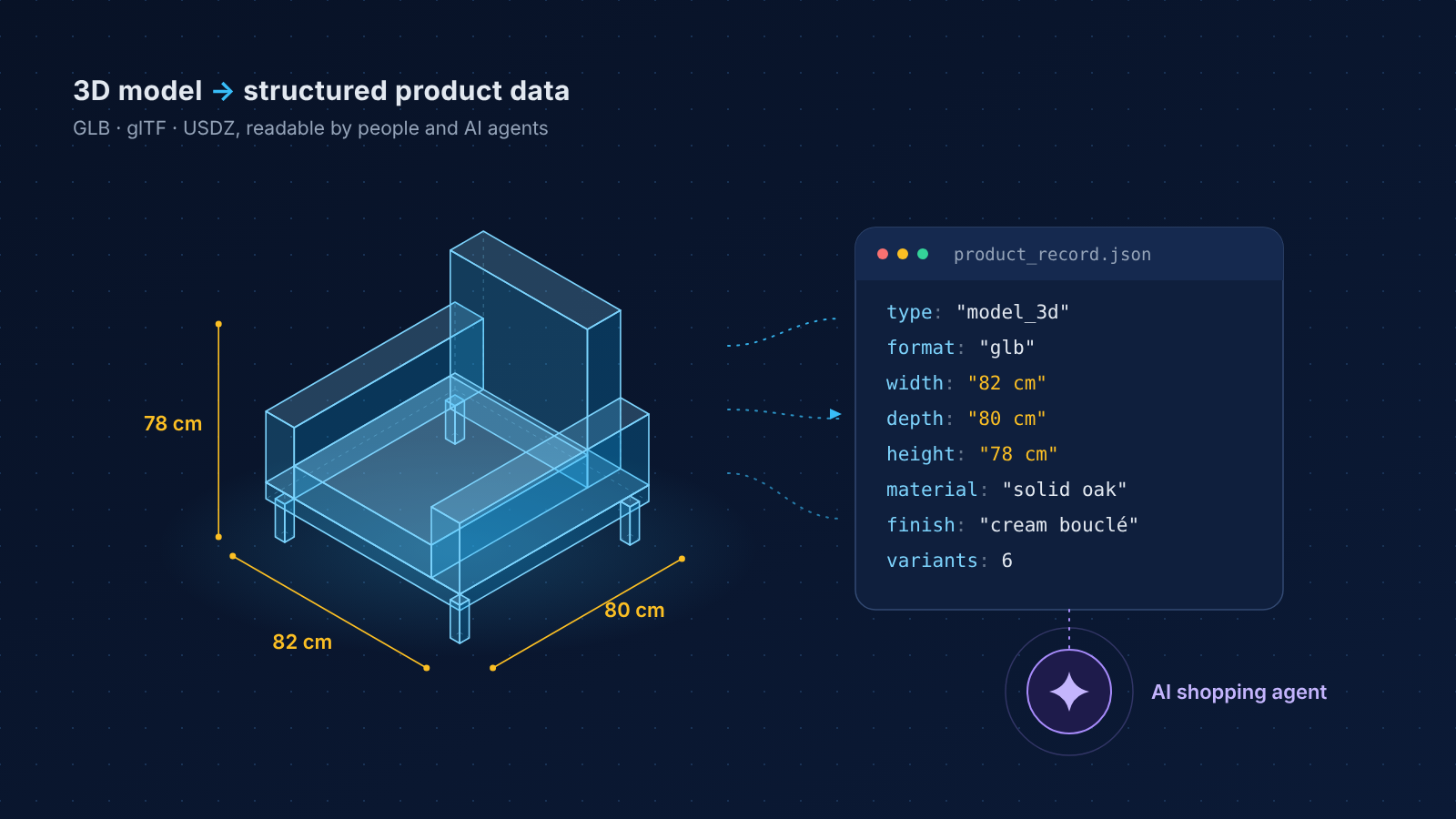
What the new model_3d media type in the Universal Commerce Protocol means for retailers, and how to get ready before the holidays
For most of the last decade, a 3D product model has been something you show. It sits in a viewer on the product page. A shopper spins it, maybe drops it into their living room in AR, and hopefully buys.
As of last month, a 3D model is also something you send.
On 29 September 2026, the Universal Commerce Protocol (UCP), the open standard Google and more than twenty partners launched at NRF in January, merged a change that gives product media a proper structure. Images, videos and 3D models are now distinct, typed items in the product record an AI agent receives. A 3D model has its own type, model_3d, with room for a GLB file, glTF and USDZ alternates, and a preview image. On 22 October, the change was backported to the two UCP versions most merchants run today.
It sounds like a small schema update. It's actually a shift in what 3D is for.
Why this matters now
Three things happened in the same few weeks.
Agents now read feeds first. According to Profound data reported on 8 October, merchant feeds supplied about 65% of the product recommendations ChatGPT made as of early September, up from about 8% before a jump on 10 July. Over the same period, the number of unique merchants ChatGPT cited fell from 13,524 to 10,607. The pool is consolidating around stores that hand agents clean, structured data.
Agents are going mainstream. Stripe's John Collison said this month that agentic activity "as of September, basically started going vertical." TikTok's new Buy Direct feature runs on UCP. Google says UCP already enables direct checkout for hundreds of thousands of brands and retailers.
Shoppers still don't trust agents with big purchases. American Express data released on 6 October found that 66% of shoppers are comfortable letting an agent compare prices, but only 15% trust one with a big-ticket purchase. And a PYMNTS survey published on 23 October found that 40.2% of U.S. shoppers would send their agent to a large marketplace rather than a brand's own site, even at the same price.
Put those together and the question for any retailer selling sofas, sneakers, lamps or luggage is simple. When an agent is comparing your product to a marketplace listing, what does it actually know about yours?
What changed in UCP, in plain terms
Before this update, product media in UCP was essentially a list of image links. An agent could show a photo. It couldn't tell whether a link was a photo, a video or a 3D file, or which version suited the device in front of it.
Now each media item says what it is. There are four well-known types: image, video, external_video (for YouTube and similar players) and model_3d. Each item has a primary url, and can list alternative sources, each with its own MIME type, format and file size, plus a preview still and alt_text.
A simplified 3D entry looks like this (illustrative; check ucp.dev for the current schema):
{
  "type": "model_3d",
  "url": "https://cdn.example.com/lounge-chair-oak.glb",
  "name": "Lounge chair, natural oak",
  "alt_text": "Oak lounge chair with cream bouclé seat",
  "preview": { "type": "image", "url": "https://cdn.example.com/lounge-chair-oak.jpg" },
  "sources": [
    { "url": "https://cdn.example.com/lounge-chair-oak.glb", "mime_type": "model/gltf-binary", "format": "glb" },
    { "url": "https://cdn.example.com/lounge-chair-oak.usdz", "mime_type": "model/vnd.usdz+zip", "format": "usdz" }
  ]
}
Three details in the spec are worth noticing:
- Order matters. Media is an ordered list, and stores should put the featured item first. If your 3D model is your best asset, it can lead.
- Agents must not reject what they don't recognize. A product won't be dropped because an agent can't render 3D yet. You lose nothing by adding it early.
- Every 3D model should have a preview. Agents that only show stills still get a good image. Agents that can render 3D get the model.
UCP isn't alone. OpenAI's ChatGPT product feed already lists a model_3d_link field (GLB/glTF) as recommended rich media, alongside video_link. The two biggest agent ecosystems now have a slot waiting for your 3D file.
The real shift: from pixels to proof
Here's the part that matters most, and it isn't about rendering.
An AI agent can't measure a sofa from a photo. It can't tell whether a lamp is brushed brass or gold-painted plastic. It can guess, or it can read what you tell it. When the answer is wrong, the shopper finds out at delivery, and the agent's next recommendation goes to someone else.
A properly built 3D model is different from a photo. It contains true dimensions. Its materials are defined, not implied by lighting. Every color and finish variant is a configuration of the same model, not a separate guess. In other words, a 3D model is a measurement of the product, not a picture of it.
That's why we argued in our last post that 3D is the fastest path to accurate metadata. The UCP change takes that one step further. The model itself can now travel with the product record. The agent gets the data you derived from the model (width 82 cm, oak, cream bouclé) and the model those facts came from.
For the big-ticket categories where only 15% of shoppers trust an agent today, this is the trust gap in a nutshell. Shoppers hesitate because they can't verify fit, finish and scale. 3D is how you let them, and now their agent, check.
What this doesn't change
A few honest caveats.
- No release tag yet. As of 23 October, the media changes were merged and backported, but not yet in a tagged UCP release. Expect agent support to roll out unevenly over the coming months.
- Attributes still do the heavy lifting. Agents rank and filter on structured fields such as dimensions, material, color and conversational attributes. Google says lululemon's brand-submitted conversational attributes were used in half of relevant AI Mode recommendations. A 3D file without matching attributes is a missed opportunity.
- Consistency is now enforced. UCP's August release expects your feed, structured data and checkout API to agree on price, stock and return terms. The same will apply to your media: a 3D model that shows a variant you no longer stock is worse than no model at all.
A five-step plan before the holidays
- Inventory your 3D assets. List which SKUs have models, in which formats, and whether each model matches the current variant set. Most catalogs have 3D for a fraction of SKUs, often from different vendors and in mixed quality.
- Standardize on GLB, with USDZ alongside. GLB is the primary format in the UCP examples and the ChatGPT feed. Keep USDZ for Apple AR. Compress for mobile, add a preview still, and serve over HTTPS with correct Content-Type and CORS headers.
- Derive attributes from the model, not the copy. Pull width, height, depth, weight, materials and finishes from the 3D source and write them into your feed and schema markup. One source of truth, three surfaces.
- Add the media fields. Populate model_3d_link in your ChatGPT feed. If you're on UCP, structure media as typed items with your 3D model and video ahead of secondary images for the categories where they matter most.
- Test with a real agent. Ask ChatGPT, Gemini and Perplexity about five of your best-selling products. Note what they get wrong about size, material and variants. Repeat after you publish and track the difference.
The takeaway
For years, the case for 3D was conversion: shoppers who spin a model buy more and return less. That case still stands. But the bigger case is now about being understood. As more shopping runs through agents, the retailers that win will be the ones whose products can be measured, compared and verified by software, not just admired by people.
A 3D model used to be the most expensive picture on your product page. As of this month, it's the most complete piece of product data you can send.
MetaZtech.ai turns product catalogues into structured 3D and semantic data that people and AI agents can understand. If you'd like to know how agent-legible your catalogue is today, request an audit.
Sources
- Product video and 3D in UCP, step by step, UCP Checker, Oct 23, 2026
- Universal Commerce Protocol: what changed since February, Oct 9, 2026
- ChatGPT Shopping Now Pulls Most Product Picks From Merchant Feeds, ALM Corp, Oct 8, 2026
- Shoppers Would Send AI Agents to Marketplaces Over Brand Sites, PYMNTS, Oct 23, 2026
- TikTok Turns to Shoplazza to Power Agentic Commerce Offering, PYMNTS, Oct 19, 2026
- Stripe agentic commerce revs up, Payments Dive, Oct 15, 2026
- American Express Is Telling Merchants How to Prepare for Agent Shopping, Yahoo Finance, Oct 7, 2026
- Boost your holiday sales with these agentic commerce updates, Google, Sept 16, 2026
- ChatGPT Product Feed (2026), Lengow